Tuesday, April 5, 2011

When All The World Is Fire


In coming to comment on Lowboy, I really wanted to understand the algorithm of thinking that governs Will Heller: why he believes what he believes and why he carries it to such extreme lengths. Beliefs stem from thoughts which stems from interpreting phenomena, therefore, why in the world(or why in the world of Will)would he believe his interior pyrolysis to be that of the world’s? Do we not all—at times—infer some phenomena incorrectly and disembark from that inference to a plundered habitation, salted and bleached of fertility? Basically, don’t we all screw up at times with interpretation of phenomena? I would need a myriad pair of hands to find the fingers sufficient to enumerate my mistakes. Fact. But why Lowboy surrendering his life for what we perceive as a misperception? Why is he so indebted to this thought that he is the sole device to save the world from irrevocable destruction?
Spelunking the internet for research material, I stumbled upon a paper by Shawn Gallagher where he reproduced two models employed by British neuroscientist Christopher Frith positing how the average person goes about thinking (Copyright University of Central Florida) as opposed to those afflicted with paranoid schizophrenia (Copyright University of Central Florida). Frith asserts that it is imperative for human thought to contain an “efferent” or compressed copy of the variables that are “intention,” “thought generation,” and “actual stream of consciousness,” so that an intended end may be replicated without the stress and strain that actually achieves that thought’s end. This principle allows a person to have a sense of agency and a sense of ownership, thereby, enabling an individual to rationalize whether their track of thinking is the best course of action or whether there is another course which might better achieve the person’s desired end.
In those people dealing with paranoid schizophrenia, the thought process is devoid of an efferent, thus giving rise to instances of auditory hallucinations which are a concomitant of schizophrenia. The Mayo Clinic describes these hallucinations may be simply “the patient’s own voice dissembling in a ‘God-like’ sort of omniscience”(Mayo Clinic) that seems to contain and express the totality of knowledge in a sum that would best be described as illogical and severe by those of average thought processes. A reason for this “illogical summation” of thought may be found in an article written by Sharon Begley detailing a medical study “led by Drs. David Silbersweig and Emily Stern of Cornell Medical School [who]teamed with colleagues in London to scan the brains of schizophrenics in the throes of hallucinations. As soon as an imagined voice spoke, or a vision appeared, a patient pressed a button. That told the scientists when to scrutinize the scans for abnormal activity. They found plenty. When one patient reported seeing dripping colors and severed heads, for instance, the parts of the sensory cortex that process movement, color and objects became active[…]’The visual hallucinations are usually fragmentary,’ says Dr. Richard Wyatt, chief of neuropsychiatry at the National Institute of Mental Health, ‘not the elaborate things in the movie. They're an outline, or a figure without features’”(Begley).
What skins this outline for Heller, this “figure without features?”(Begley) For Will, it seems that he has ordained his doctors—specifically Dr. Fleisig—as co-formers of his world, or at least those artists that help him to understand what he experiences. The reason for Will’s body getting hotter? “[Dr Fleisig]put degrees into my body”(Wray 173). Why did Dr. Fleisig put degress into Lowboy’s body? “Hot flashes are a known side effect of Geodon but I could prescribe some Risperidone for you in addition if you’d like”(Wray 174). Dr. Fleisig’s prescription to aid Heller handle his schizophrenia includes the boy’s body temperature to rise noticeably and Lowboy infers—tacitly—that this man—whose first name he remembers as “End of Days”—must hold the answers and key to help Heller unlock what his mind(or the hallucinatory mind, depending on your perspective)tells him.
Was it not Dr. Fleisig who off-the-cuff first made mention that “[t]he whole world’s getting hotter so they say”(Wray 174)? In this one phrase, Lowboy finds the purpose in his life, a life where everything “has to mean something”(Wray 163). If Lowboy is incrementally getting hotter—as is the world—there must be something Lowboy can do to relieve the stress of Earth’s molten core and gaseous strata layers enveloping it. The solution for this dilemma, again, stems from Dr. Fleisig’s treatment and care:
The question of my penis is an ongoing question. My penis seems to be a kind of Answer. I took it out during TV hour & Prekopp & Fleisig & everyone else stared & hummed at it & let it happen. Another sign that things might be improving. My unzipped pants like Direct Cable Service. I’m not dead Violet. I’m not even tired. I’m making myself an airconditioned body(Wray 147).
For Lowboy, it seems the communication between him and End-of-Days Fleisig seems to take on a property that exceeds the realities of the palpable world. The auditory hallucinations—while not that of a devil or god—are effects of Lowboy’s inability to consider himself as agent and owner of actions that he himself created; the logical answers thus given by a cog in the assembly line that forms life and cognition for Heller. Lowboy is not concerned with “whom” it was that sparked resolution out of a problem, but simply that what he is undergoing has kinship with another process alive in the world and in this similitude, therein lies the purpose of his own life: Agreement.
The intended end that is created by Lowboy—his own suicide thus saving the world—is heartbreaking, yet the ingredient of Lowboy’s own altruism is unavoidably heart-mending. Begley continues in her article that people dealing with paranoid schizophrenia have “the inability to tell what is real from what is imaginary”(Begley): the burning bush speaking with the voice of God is the sewer grate where heavy rains cause quasi-runnels to rush through the slats: the miraculous is the mundane. Lowboy’s suicide is kin to a sigh in his mind—there is nothing in this act but a response to phenomena, however illogical this response may be for anyone else. The calm and quietness with which the novel draws to its end is evidence enough, “’Why was I born,’ Lowboy thought. ‘I know why.’ He made a face and took a slow step backward”(Wray 258) that what other end but “ On November 12 the world ended by fire”(Wray 258).
Two weeks ago, I set out to sketch the face of my father: yes, the task was one-part inspiration from Lowboy’s same endeavors as is declared with the device of flashback in Lowboy and one-part embarrassment that I could not remember the shape of my father’s face. Upon putting pencil to paper, my embarrassment deepened and intensified when it was that I could not grasp the shape of my father’s face whatsoever. I returned the pencil to my shirt pocket, balled up the sketch paper, and pitched it into the trash. I can give you my father’s name on cue if questioned about it; ask me to assay the theatrics of his gait and the time of day when he takes his supper, and I’ll be as lost as if recounting the dimensions and properties of thermodynamics.
Such is the father to the son…my mind wanders.

WORKS CITED
Begley, Sharon. http://www.newsweek.com/2002/03/10/the-schizophrenic-mind.html.
Gallagher, Shawn. “Self-Reference and Schizophrenia: A Cognitive Model of Immunity to Error through Misidentification.” Exploring the Self: Philosophical and Psychopathological Perspectives on Self-experience, ed. Dan Zahavi. Amsterdam & Philadelphia: John Benjamins. 203-239.
The Mayo Clinic. http://www.mayoclinic.com/health/paranoidschizophrenia/DS00862/DSECTION=symptoms
Wray, John. Lowboy. New York: Farrar, Straus and Giroux, 2009. Print

Saturday, March 12, 2011

No Two Know The Same Thing, And This, The Twain Knows


Copyright of Google Pictures
My wife and I woke on a Saturday morning; after stretching our bodies to realize their corporeality and after going through ceremonies of purging said bodies of torpor and fluid retention, we rejoined together in bed and began discussing with each other what dreams did rise to meet our unconscious through the night. We went through various permutations of story-telling antics, disseminating sense as if it were contained in hand gestures, nicitations, fluctuations and accents of voice, and general revolts of calm-bedlam that belied the sensibility of our dreams simply to translate the inherent “spirit” with which we experienced our dreams. Needless to say, vitamins, oatmeal, and orange juice were the comestibles in order after our vaudeville.

I told Amanda later that Saturday morning of a ceremony performed by a tribe of the Australian Aborigines—Unmatjera—that I had read about in Sir James George Fraser’s The Golden Bough which initiates male members of the tribe into adulthood. To paraphrase the litany of requisite rituals that comprise the ceremony, the young man is slathered, from head to toe, with dingo blood which is used to ward off devious and beguiling spirits who would seek entry into the cynosure’s body during the circumcision ceremony which follows the dingo-blood soak. The young man’s father than gifts him a churinga, or magic stick which is said to be part of the initiate’s spirit and therefore, in the remotest vales and purlieus of the young man’s former incarnations. He is to take the accumulation of his soul’s experiences upon the earth with him—codified as memories in his heart, and knots on the churinga—out into the forest, alone, and defend himself through the night and dawn against whatever revenant or gaberlunzie should manifest itself and seek revenge to the boy’s past deeds and heroics which might have fitted these monsters and beggars to their own extinction from bone (Fraser 803).

Granted, this story could be termed grizzly and bizarre, but as Amanda and I talked about it, she evinced a theory that caused me to pause in my eating of oatmeal, which in and of itself—refraining from eating—is a monumental event: she basically revealed that what causes revile and shock within her retaining my adumbration of the ceremony is that it(the ceremony)is contrary to her own algorithm of how a child ought to transmogrify from child to adult. Barbaric it might be, the ceremony—while parenthetic—reflects the zeitgeist of the Unmatjera’s interpretation of its witnessing the universe, the earth, the animals, the peoples, and spirits, which encapsulate and define the experience of being a Unmatjeran.

Thanks to the Unmatjeran, Sir James George Fraser, my wife, and dingoes, I was able to identify in our reading of Enduring Love that there is a case to be made that defining Jed Parry in terms of De Clerembault may seem apropos—insofar as Joe Rose is concerned—but compassed against how other characters in the novel respond to experience and interpret some facet of the experience for themselves in order to make sense of the experience, I daresay that Jed Parry may simply be a man who in a moment of turbidity, simply inferred a sign or signal in the only way he knew how with what faculties he was bedighted; as might any human being.

A most telling line of verse from Parry’s love letter to Rose reveals what he(Parry)saw and why he saw it in Rose’s face in the pasture—Logan set between them as a doleman, measure in rifts rather than in joints—is because Rose was beseeching Parry—in whatever phrasing of mien the face rotated through—to “mend [his] rift with God through the healing power of love”(McEwan 106). Nothing more; nothing less. Parry’s—Rose’s—own inabilities in continued attempts at rescuing Harry from the run-away balloon—although the boy was brought to safety organically by wind and route—causes both men, invariably, to kneel before the inefficiency of human capacity and serve another, more remote habitation of the self, a ceremony that causes Parry to infer that it is love and salvation Rose seeks from him.

And very well that Rose might have been cogitating through the realms of love and forgiveness and salvation because of the severity of the experience and the shared-failing of each man. It was not in the capacity of any man there that day to save the boy and Rose points to it: “Our misery in the aftermath was proof that we knew we had failed ourselves. But letting go was in our nature too. Selfishness is also written on our hearts. This is our mammalian conflict: what to give to others and what to keep for yourself”(McEwan 15). What would Rose keep for himself—that quotient of misery in his failures—and what of it would he give away? Perhaps he was mired in the confluence of this reckoning when his mien met Parry’s; and perchance Parry—a man guided by his interpretation of God, love, and forgiveness—interpreted such ideas as “love,” “forgiveness,” and “God,” out of Rose’s glance. Did not Rose enact the same theory when going to see Mrs. Logan that afternoon, walking up her driveway and noting that “[i]t would have been too easy to assume that the sadness coming off the house was mere projection, and I made myself find the signs: the neglected garden, closed curtains in two upstairs windows, and, below the steps by the door, broken glass—of a milk bottle, perhaps” (McEwan116). So much is going on in Rose’s mind, eg, antecedents of the conversation he was to hold with Mrs. Logan, her husband’s death, etc., that he makes himself look for signs that the sadness coming off the house is not of his own devise—that this sadness exists in the world with Mrs. Logan—and Mr. Logan’s death more appropriately—as the fulcrum in its provenance.

As scientific and rational as Joe Rose is, he persistently forbears the identity of variegated self existing outside of the scientific and rationale; as if whatever “stuff” the self is resultant of exists in a time and order that is consistent with what amounts to solipsism. In one passage, he reflects a bit like a poor man’s David Hume when Rose notes that “[p]eople often remark on how quickly the extraordinary becomes commonplace. I think that every time I’m on a motorway at night, or on a plane as it rises through cloud cover into sunlight. We are highly adaptive creatures. The predictable becomes, by definition, background, leaving the attention uncluttered, the better to deal with the random or unexpected” (McEwan 151). The quotients of predictable, random, unexpected, extraordinary, and commonplace are set forth as defined by Rose’s gauging of them, a rudimentary tableau that is girded to his template viewing of the world. This seemingly allows no other’s algorithm placement in the determination of what has happened and how to deal with it. It is as if phenomenon and/or experience are essentially—for Rose—identifiable and classified by the spoors left after the experience relents and the skeleton hand unclenches its grip on your collar; experience being no more than the opportunity to dilute the mammoth into a puddle that is, again, measurable, quantifiable, and researchable so rather than the entirety of an experience being overwhelming, a synecdoche of sorts—for Rose, focusing on his failures as scientist, as hero, as altruist, as lover, etc.—allows the part that is familiar to cognition becomes the whole and therefore, any hypothesis wrung out of the microcosm is interpreted to represent the value of the macrocosm which has been sorely interpreted.

Hume wrote that “[we are] nothing but a bundle or collection of different perceptions, which succeed each other with an inconceivable rapidity, and are in a perpetual flux and movement” (Hume 252). Neither man leave room for the essential faculty of man’s ability to discern, to perceive and discern what is presented to a human. The miasma of Rose punctiliously working a scalpel through what “went wrong in the system” that might have led to Parry’s irrational belief that he(Rose) is in love with him exacts the notion that Joe Rose is a man who believes the world to his own cognition and senses; whatever is recondite, is dismissible.

Yet doesn’t every character in the novel press through the singular experience shared that Sunday afternoon by focusing with their own eyes? through the prism of their own experiential self and its algorithms that govern how each man and woman “experiences experience?” While Joe may seem cold and unaffectionate, what would we term Mrs. Logan as when her husband’s death becomes the impetus to focus on whether or not he was having an affair on her? And what of Greene, who would rather lodge his notion of the shared-experience in terms definable by “his ankle, or the sick pay he should have been receiving on its account”(McEwan 156)? Or Gadd who barks that he will say what he has to say in “a coroner’s court”(McEwan 157)?

And what of Clarissa’s discerning in her letter to Joe that:
“You asked me last night if I realized that you had saved my life. In the immediate sense, of course, that’s true. I’ll always be grateful. You were brave and resourceful. In fact, you were brilliant. But I don’t accept that it was always inevitable that Parry was going to hire killers or that I should end up being threatened with a knife. My guess was that he was always more likely to do himself harm…by drawing Parry in, by overacting all along the way, by guessing his every next move [it was as if]you were pushing him toward it” (McEwan 235).
Rather than ascribing what is perceived as irrational behavior to a condition like De Cleremabult, Clarissa asserts that Joe’s over-analyzing of the situation, and not simply compassionately viewing from Parry’s vantage that perhaps a simply twitch of the lips or dilation of the eyes may have been the stimuli for Parry to reach what he perceived as a logical interpretation(while such an interpretation may very well have been not simply desultory to the stimuli created by Rose, but anachronistic)actually caused the calamity to befall Joe and Clarissa; and while Joe may have been the hero in saving her, he may also have been the flamen who called forth the plague and pestilence to which he was unconsciously aimed.

J.S. Wiener writes that “[t]he interaction between men and their environments, natural or artificial, will always invoke biological change, as immediate responses through developmental and physiological adjustment and as long term responses through selection and other agencies” (Wiener 7), the word, environment, here as portmanteau for all things surrounding Man: place, climate, culture, and Man itself. But this change, of biological concern, will always be glassed with the devices that allow man and woman survival as Gary Snyder expatiates:
“Staying power through history is related to the degree of intentionality, intensity, mindfulness, playfulness, and incorporation of previous strategies and standards within the medium—plus creative reuse or reinterpretation of the received forms, plus intellectual coherence, time-transcending long-term human relevance, plus resonances with the deep images of the unconscious” (Snyder 79).
Yes, Mankind does change and adapt to environment by that environment acting upon it; but, we must first fail—that is essential. We are only what we have experienced and inferred and as such, we must allow ourselves to fail with this calculus so we might endow to ourselves a creative reusing or “reinterpretation of received forms.” During the struggle to land the hot-air balloon, Rose recalls, that the men “heard nothing for our own shouting and swearing. What [the pilot] was doing seemed ridiculous, but his intentions, it turned out, were completely sensible. He wanted to deflate the balloon by pulling a cord that was tangled in the basket”(McEwan 12). Distanced from the moment, Rose sees rationale where at once he saw discord and antithesis to his own sensibility. Might the same rune be used to intimate that each person in the novel was correct as well as wrong? The factual experience that day of the hot-air balloon tragedy is incontrovertible; but what is malleable is how each person received and inferred data from that day and experience and came to a conclusion that befit how they fit together any piece of datum. The Irish poet and playwright James Cousins devised a wonderfully simplistic diagram to say as much:


Copyright of Journal of Generalism and Civics, Scotland

As a great friend of mine once said, “No two men know the same thing, and this, they know.”


WORK CITED
Hume, David. Treatise of Human Nature. Oxford: Oxford University Press, 1946. Print.
McEwan, Ian. Enduring Love. New York: Anchor Books, 1997. Print.
Snyder, Gary. The Practice of The Wild. San Francisco: North Point Press, 1990. Print.
Weiner, J.S. The Natural History of Man. Garden City, New York: Anchor
Press/Doubleday, 1973. Print.

Wednesday, February 9, 2011

Mine eyes have seen the glory of the coming of stone

“What discordant vespers do the tinker's goods chime through the long twilight and over the brindled forest road, him stooped and hounded through the windy recrements of the day like those old exiles who divorced of corporeality and enjoined ingress of heaven or hell wander forever the middle warrens spoorless increate and anathema”(McCarthy 24). From whatever neuron or systole this liturgy did break, I dare say that it exists in that state the author of this verse, Cormac McCarthy from his 1968 novel Outer Dark, terms as “increate,” which is a concise way of saying that something is not yet created. After reading Dr. Ramachandran’s work The Tell-Tale Brain and specifically his delving into syntax, language, and semantics, a nascent hypothesis formed in my own grey matter that made me want to spelunk deeply the idea that language formed out of an evolutionary process—exaptation—that is, that what manners and modes were lashed with membrane and pulse to create a certain system and thereby, evince a certain product, could have evolved further to perform perhaps what may be termed “legerdermain,” and this trick, so expertly delivered in some folks, is called “language.”

What genus could language be itself placed within is a territory far better suzerained by linguists and shaman, but here, I’ll declare that language is a tool: as much utilitarian and practical a device as vice-grips, miter saws, and lathes. This implement—language—allows humans to express, convey, mitigate, mediate, and therefore think deeper and respond to the external and internal world, borne out of what is nothing more than mere conjecture and amorphousness, to establish a corporeality that endows humanity with its most sacred of epaulets: relationships and evolution on a microcosmic scale or, more simply, maturation.

Rather than glassing the presence and development of language out of a lens in thrall to the ecclesiastical, ie, Alfred Russell Wallace who presumed language was placed in the brain by God (Ramachandran 165)—and what of those atheists and agnostics who either denounce or are discomfited to the presence of a God? Might they be(according to Wallace)mute and incapable of voicing language if such a hypothesis as his(Wallace)be taken as sacrament?(pun intended)—or Chomsky’s insight that perhaps language is the result of emergence(a deus ex machina suspired into ossification from the concordance of disparities that is the brain’s wires, creating that latent god out of its own creations, its own victuals(an order borne out of the caste system that it ascribed))the that is to say, an occurrence due to “100 billion nerve cells[packed]into the tiny space of the human cranial cavity(165)and therefore, the mélange bore the salient, I am much intrigued by Stephen Jay Gould’s intimation of exaptation, the process in which a feature goes through permutations and thus acquires functions that were not imprimatur coeval with natural selection. If areas of the brain devoted to all things analogous to language(but not originally language itself)and all those serried parts found language through their/its own delineation, then the creation of language, to use McCarthy’s words, is not a spoorless event and body.

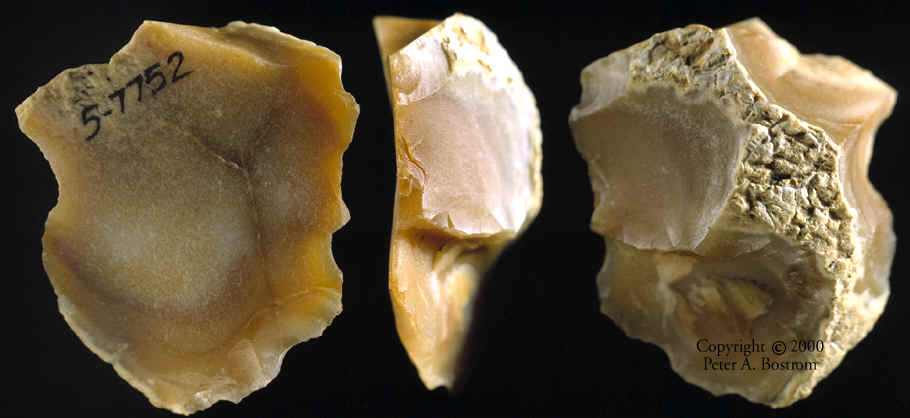
If syntax, as Ramachandran postulates, is an aspect of language delivered from the faculty of aptitude for tool-making(181), then why not language from the same mother? Homo habilis, an early antecedent of Homo sapien that populated East Africa near 2.3 million years ago (Stein 356), is deigned as the first active hominid in Earth’s history to articulate utilitarianism out of crudeness (Stein 356). In Christopher Croom’s essay delineating the evolution of language(be it in concord with the vertebrae’s eye or the bird’s feather), he delivers the discovery that Homo habilis, as a word, translates to “handyman”(Croom). The picture exhibited ahead shows early Oldowan(named for the gorge in Tanzania in which the tools were found)tools created by H. habilis; these flakes are composed of chert and were used much in the same manner as arrowheads by Turtle Island’s(America)aboriginals. Many scholars believe the ability to create tools was/is an apt emblem that H. habilis “may have had greater cognitive capabilities than his precursors”(Croom).


By taking cranial endocasts, plastic casts of the interior of a fossilized hominid’s skull, Croom reports that scientists were able to determine that:
the parietal, occipital, and temporal lobes of the brain merge for the first time in Homo habilis, creating an area of the brain called the POT, or Wernicke's Area. Broca's Area,
one of the other highly important areas involved in language production and processing, can supposedly also be observed for the first time in the hominid line from endocasts of Homo habilis skulls. The argument that follows from this evidence is that the Broca's and Wernicke's areas were selected for in Homo habilis in order to make tools (and probably also for gathering food and hunting), but were subsequently exapted by later humans for the purposes of language production and processing(Croom).


Now, this does not cement the idea that language began with the handymen of the Lower Paleolithic, it is an intriguing idea that those areas of the brain—Broca’s and Wernicke’s areas—responsible for syntactic structure(Ramachanrdan 295)(which could be synonymous with constructing a tool, properly, in fit and handle, to reach the hominid’s desired end, ie, dead animal=dinner; felled brush and trees=shelter,etc) and for comprehending language and producing writings and speeches that are anything but platitudes(305)(which in and of itself could be congruent with the idea that while you may have a functioning side scrapers, knives, choppers, picks, and hand-axes, their sustainability and well, beauty, may have attracted, in addition to food, shelter, etc., those amorous companions who allow the lineage of a species, family, and identity to continue and flourish)were also undoubtedly merged during the “durance” of our earliest hominids within cavities and bodies that were at once thought to be rudimentary.

Growing from this idea, Dr. Mark Liberman introduces—in his essay “Darwin and Deacon on Love and Language: —the idea that while tool-making was the genesis of language, the systole that marks language as evolving and refining itself is the old “hunter-gather-mate,” concept. Liberman quotes Terence Deacon’s book The Symbolic Species,” in saying that what began as communicating in symbols(grunts, groans, calls, etc.)evolved into something much more richer and, well, easier:

Even a small, inefficient, and inflexible symbol system is very difficult to acquire, depends on significant external social support in order to be learned, and forces one to employ very counterintuitive learning strategies that may interfere with most nonsymbolic learning processes. The first symbol systems were also likely fragile modes of communication: difficult to learn, inefficient, slow, inflexible, and probably applied to a very limited communicative domain[. . . .]Neurologically and semiotically, symbolic abilities do not necessarily represent more efficient communication, but instead represent a radical shift in communicative strategy"(Liberman).

In keeping with this idea of language being concomitant of tool-making and symbol-usage, if one does not find ways to eat and keep from the elements(cold, heat, wind, rain, etc.), that being perishes; parallel to this idea, if one does not procreate, that being(and perhaps, that species and lineage)perishes. Be it ego or an embodiment of guile, human beings are like sparrows, snakes, and alligators: None of them want to die. Thusly, Liberman, in quoting Deacon, postulates that what symbols were used as warning, defense, or in conquest, were then transmuted into wholly new articulations(tool-making into language)that bespoke of one’s vitality and ability to procreate and sustain lineages—call it a primordial social contract akin to marriage:

The pair-bonding relationship in the human lineage is essentially a[ . . . ]set of promises that must be made public. These [. . . ]implicitly determine which future behaviors are allowed and not allowed; that is, which are defined as cheating and may result in retaliation[…](f)or a male to determine he has paternity certainty, requires that other males also provide some assurance of their future sexual conduct. Similarly, for a female to be able to give up soliciting provisioning from multiple males, she needs to be sure that she can rely on at least one individual male who is not obligated to other females to the extent that he cannot provide her with sufficient resources(Liberman).

Such is the provenance, perchance, of the execrations, the vespers, the frightful liturgy, and awe-inspiring expatiations that were once laved in a caul that first brought with them, a taste of iron and wood, and when diffluent, thus melted down the throat and traced in the as stomach the earliest pangs of riveting branch-to-branch, arc-to-arc, mortise-to-tenon, that bloomed out of a moiling, itself both arduous and exploratory, which would measure Homo habilis as to its capacity for evolving and witnessing the permutations of its developing and future society as in thrall to the vicissitudes of those hominins at present in our past. And thus, rather than working to exclusively build temples, out-houses, forts, and pyres, efforts themselves diluent if none would be standing in generations yet to to come, these hominins sought to urge a topography for animate beings’ emotions, desires, wants, and intimations through spoken words, their order and phrasing near encomium, to the condition of being alive.

P.S. I included a great video starring David Crystal, a British linguist who wrote a wonderful tome entitled Walking English which explored the dialectical spread of Gaelic throughout Ireland, from Kerry to Derry. Dr. Crystal appears on a BBC show in the video declaring his theory that text messaging is in fact encouraging literacy. Have a peek:


WORKS CITED
Croom, Christopher. “Language Origins: Did Language Evolve Like the Vertebrate Eye, or Was It More Like Bird Feathers?” csa.com. Cambridge Publishing Group, 2003. Internet. Wed. 9 February 2010
McCarthy, Cormac. Outer Dark. 2nd ed. New York: Vintage, 1993. Print
Ramachandran, V.S. The Tell-Tale Brain. New York: W.W. Norton & Company, 2011. Print
Stein, Phillip L., and Rowe, Bruce M. Physical Anthropology. 9th ed. New York: McGraw Hill. 2003. Print
Liberman, Mark. “Darwin and Deacon on Love and Language.” Language Log. 2nd ed. University of Pennsylvania, 2004. Internet. 9 February 2010.

Thursday, January 27, 2011

My name is Paul, spelled with a "p" like in "ptolemy"

I love William Faulkner. I do not love William Faulkner with the urgency, thrust, capacious lust, and thrall that attends my love for my wife Amanda; but I love William Faulkner. Yesterday morning, driving home from work, I began to think of a passage from Faulkner’s seminal novel Absalom!Absalom! and its application to the our novel under consideration in class as well as in consideration to Boone’s monologue on constellations that I keep regenerating in class like an anathema does the pneuma of his/her Lord who has indicted their supposed venial peccadillo as blatant heresy: I hope to make myself see the clarity that I know is there, but that I know hides like eyeshine in twilight. So in cogitation on the poetics of constructing constellations under the auspice of animals, gods, and goddesses as template, I considered the origin of such a practice while leafing through a folio of Harry Partch recordings on my Walkman; Partch himself was deeply influenced by the Babylonian and later Grecian harmonic as well as the Oriental tradition of composing scales and pieces of music.

Here is evidence of Partch’s musical splendour and genius:

So, the art of astronomy ostensibly begins with the Babylonians around 3200-3800 years ago, according to relicts discovered that were ascribed as the “Babylonian Star Catalogs” I really don’t know much about these documents, eg, who discovered them and when, but a star catalog is simply a charting of the skies. A wonderful academic article appears from Dr. Robert Powell charts the provenance of Babylonian astrology and naming: http://www.astrogeographia.org/articles/BabylonianZodiac (Powell). Babylonian divination-priests were de were the agents who excoriated the sky with lines to connect star to star in such a way that reflected the proclivities of each season and ascribed to each star a corporeal sensibility and a name which corresponded. So the Greeks came later and charted further adumbrations of what were to become the modern zodiac and cosmological blueprint of the sky’s constellations.

Understood, but what is missing here, as far as I can see from my vantage point, is the POSITION of peoples in viewing these stars and corresponding celestial bodies. Babylonians had a perception of the sky and so too did the Greeks from both a geographical positioning as well as a subtle, mental zeitgeist that positioned them, creatively, in their analytical thinking on all things theological, empirical, and theoretical. The graphic embedded in this blog post is from the University of Tennessee’s website detailing the folio of constellations as if one were looking at a boon that is flattened and spread out at its sagittal plane:


(http://www.physics.unlv.edu/~jeffery/astro/constellation/constellation.html)
(c) University of Tennesse, Mount Wilson Observatory

But each individual has a differing geographic station on the earth from which they view this tome. The following links are examples of the same sky of those people located in Kent http://ftp.fourmilab.ch/cgi-bin/Yoursky (Walker)and those people located in Johannesburg, South Africa http://ftp.fourmilab.ch/cgi-bin/Yoursky(Walker)on January 25th, 2010. Now, librations make volatile these fluid skeletons of fire and gas, but the gist is that to each person, their axis and rays.

Thus, it seems that Christopher’s postulation on constellations being delineated “arbitrarily” as he is concerned (Haddon 125) as well The Monty Hall Problem (Haddon 64-5) both are correct unto themselves as evinced by Boone and, as well, as to a theory expounded on by William Faulkner in his novel Absalom! Absalom! that is used to describe Miss Rosa Coldfield as seen by Quentin Compson who sits in consideration of a story she is giving on Thomas Sutpen. Miss Coldfield, as inferred by Quention, is“[…]a barracks filled with stubborn back-looking ghosts still recovering, even forty-three years afterward from the fever which cured the disease, waking from the fever without even knowing that it had been the fever itself which they had fought against and not the sickness, looking with stubborn recalcitrance backward into the fever and into the disease and not even aware that the freedom was that of impotence” (Faulkner 7).

Rather than meditating on and thinking through the system of a “thing;” what comprises it and how the individual parts of the system works; and the logic of how all these relations interact and correlate to each other, so many of us are apt to leap toward a logical reason based on extraneous inference on similar systems(an old truck of yours once misfired and the battery idled at a low level so when a similar problem arises in your current vehicle, you replace the battery because that is what the diagnosis became in the truck; in actuality, the flaw in the system of your current car is a ground wire leading to the coils and the battery was actually salubrious)or infer cursorily because we feel well-versed enough in the theoretic of how a system(s) should work so we “logically” give the sum as an exponent that is apocryphal to the actual problem.

But, a bad battery is a bad battery and a bad ground wire is a bad ground wire; you just have to dig deeper in logic—get into its bowels and furnaces, its pipes and cinderblocks and not merely stop eternally in its foyer and admire the symmetry of joins and cornices—to discover which agent is corrupt and which is well unto the system.

It is so much the want of man, in its mean, to answer and codify what is perceived from their own azimuth and presume that grid is how the world operates. Boone builds a resistance to this theorem by utilizing the theorem to the degree that he does not seek the world abed in his hypothesis. To say that Orion—if dismantled and recalibrated to an angle of stars as seen in other parts of the world—could not be an elephant(Ganesha or the simple, general pachyderm)is narrow and desultory; it does not correlate to logic. That is Boone’s sight-line: a latitude of logic. There are a million minds and a million eyes in this world if one; there are a million adumbrations of how and why of the mind and the eye if one. It is not that Boone—ostensibly, dealing with autism—is oblique of society, it is simply that society’s tenets are oblique to the order that life and organics have constructed. That order is a variable defined by each human animate upon this earth

WORK CITED
Donahe, Bob. “Constellations, Clusters of Stars, and Star Names.” Mount Wilson Observatory, University of Tennessee. Version Two. University of Tennessee. 2003. Internet. 27 January 2011
Faulkner, William. Absalom!Absalom!. New York: Vintage International, 1986. Print.
Haddon, Mark. The Curious Incident of the Dog in The Night-Time. 1. London: Doubleday, 2002. Print.
Powell, PhD., Robert. Astrogeographia. Version One. The Sophia Foundation. 2007. Internet. 27 Jan 2011.
Walker, John. “YourSky Sky Charts.” YourSky. Version Iterate. John Walker. 2003. Internet. 27 January 2011.


.

Monday, January 24, 2011

Fratres means Brethren

My mind has often been fraught with moving pictures of palimpsests: be it, as a cribbed child looking at the mobile lofted above me, turning at its rim with all sorts of charms and obelisks I was awed at; or be it the long falls of black hair ‘round my mother’s face as she attended me one morning in a red turtleneck sweater, her lithe, sinewy hands lifting wooden blocks of various colors or turning pages in a picture book with her sharply bent fingers, like talons, flipping the pages. To speak this acuity of childhood theatre as being similar to Boone’s capacity for remembrance in Mark Haddon’s The Curious Incident of the Dog in the Night-Time would be mere conjecture, but the singularity of these images, indivisible by anything other than the memories themselves, has driven me to investigate the prominence of Boone’s adept navigation through all things mathematical and specifically, prime numbers.

Before I begin in the mean of this post, I was thoroughly enraptured with investigating prime numbers. The government/military uses prime numbers for the purpose of public-key cryptography, passing encrypted messages only to one receiver who has the ability to “unlock” the message. Prime numbers are useful because there is virtually limitless possibility in constructing keys out of prime numbers to unlock “safe” messages. Here is a great website defining public-key cryptography: http://computer.howstuffworks.com/encryption3.htm.

It is interesting to note that prime numbers are themselves natural numbers with no divisors save for the number “1” and the prime number itself. Not that prime numbers are immutable, but that their volatile nature is only agitated by a number, “1,” that is itself a glyph of “unity” and by the prime number itself, may the consideration of “isolation” be culled out of the true value of a prime number. It is as if the number itself is given the power to shape, name, categorize, quantify, and deify or nullify, its own purpose and purlieus. Believe that a number such as “four,” if winnowing for meaning in value itself, may be divided and broken down into “two multiplied by two,” or simply “two” itself if “four” be divided by the number “two.” There is a methodology to reducing composite number, eg, four, six, eight, nine-hundred and thirty-nine; seventy-four, one-million three-hundred thousand, seven-hundred eighty-seven and twenty-two, and while the methodology is sound and relatively easy(in comparison with the functions entrusted to produce a “final” glyph for a composite number), in referencing Daniel Tammet’s postulation from an article written in study of the autistic savant by Richard Johnson of the UK’s The Guardian, http://www.guardian.co.uk/theguardian/2005/feb/12/weekend7.weekend2, the idea that a number has infinite reducibility and may be taken down by some other agent other than itself or unity(ie, black(the presence of every color) or white(the absence of every color) is what Tammet’s describes as making him “feel uncomfortable,” (Johnson).

What truly excites the mind in thinking upon this theory is, while I do not have the mental vernacular and pliability to truly understand neurological speak, here, with prime numbers as the factor in my “experiment,” is evidence as to not necessarily “what makes” people afflicted with autism socially “mal-adjusted,” but rather isolated to their own nature, something that is definable and without epaulet and the call for subtleties that so many of our cultural and societal peers and antecedents have employed. For example, during my tenure working at an inner-city Cleveland high school for at-risk/special needs youth, those young students diagnosed as autistic were(and still are)endowed with an amazing penchant for recalling memories out of their deep past: many students could recall entire days from the first years of their birth; these students could recall—with vivid acuity—stains on their mother’s or father’s shirt, how much caudle was left in a mason jar on a shelf in the kitchen at day’s end when it had been full that morning. Everything is preserved in amber of light and thread that is incorruptible to the spindle of Clotho, the measuring of Lachesis, and the shears of Atropos; a mind so brimming with remembrances and stimuli and aqueducts to troll through and examine must surely, reflexively, swathe a person in the caul of their own historicity and permutations. In the novel, Boone says that“(p)rime numbers are what is left when you have taken all the patterns away. I think prime numbers are like life. They are very logical but you could never work out the rules, even if you spent all your time thinking about them,”(Haddon 12). Everything in life is logic, but to understand this logic is recondite. But an interesting question arises: for Boone, the rules themselves may be apocryphal and therefore indefinable, but the mechanics of HOW to arrive at an answer is not.

Mr. Tammet reveals in Richard Johnson’s article that he—Tammet—was asked once by his brother to multiply the number eighty-two(itself a composite number)by itself four times, ie, 82x82x82x82. Tammet elucidates that “(m)y back went very straight and I made my hands into fists. But after five or 10 seconds, the answer just flowed out of my mouth(Johnson). He further reveals that when he saw numbers, Tammet rather “’saw' images. It felt like a place I could go where I really belonged. That was great. I went to this other country whenever I could. I would sit on the floor in my bedroom and just count. I didn't notice that time was passing. It was only when my Mum shouted up for dinner, or someone knocked at my door, that I would snap out of it” (Johnson). For Boone, in the novel, he describes deciphering answers to large numbered equations with quantifiable, logical rhetoric that seems almost plebian when recited: Edward Boone’s friend, Rhodri, quizzes Christopher on the answer to “251X864” (Haddon 66). Christopher correctly answers “216,864” (Haddon 66) and describes the mechanics for solving the equation as multiplying “864X1,000, which is 864,000. Then you divide it by 4, which is 216,000, and that’s 250X864. Then you just add another 864 onto it to get 251X864. And that’s 216, 864” (Haddon 66) Logical, yes; easy to actually resolve to the mind’s circuitry, no.
Both individuals have different avenues to arrive at the same, correct answer; as is the plethora of unique fingerprints in the worlds, so too the patterns of the human mind. Ostensibly, Boone does not exhibit synesthesia—nor Tammet, though he does describe when multiplying numbers that he sees “’two shapes. The image starts to change and evolve, and a third shape emerges. That’s the answer. It’s mental imagery. It’s like maths without having to think’”(Johnson)—Boone does equate the color “red” with passing cars that—in varying numbers of continuity passing on the road and coeval in his mind—define the level of greatness that is to be his day; or the color “yellow” under similar conditions will define a severely awful day (Haddon 24). Interestingly enough, the number “four” when referring to four consecutive red cars seen upon the road, denotes a “Good Day,” whereas the same number referring to four consecutive yellow cars denotes a “Black Day.” Though it is not cars seen, there are four consecutive instances of Boone noticing the color “yellow” while en route to his mother on the train. A composite number having polarity, while the prime numbers are allowed only one hallmark: could the paradox’ answer lie in the paradox? As answers to the Earth lie in Earth’s processes? Are answers as simple to decipher as the factors which comprise them, right before our eyes? Is there anything unique and salient to the number “four” being allowed polarity itself?

During one of my last days employed at the high school, a student and I were sitting in my office discussing his future plans: College, occupation, etc. I am not one with a predilection for indulging in ruminating on the future or inclined to romanticize about prolepses, but as a man concerned with our student’s well-being and materialization of their dreams, I found the alien mud to stand upon and believe in things I had only heretofore(at the time)considered as fable. I asked him, “Do you want to go to college or find work?” He sat wide-eyed and taciturn. I asked him, “Do you want to do both?” Again, astonished and silent, he sat. I felt enervated and nugatory. He pushed his eyeglasses back on the bridge of his nose; his eyes slanted behind the lenses and he blinked rapidly, saying, “The question I would ask myself, I already have and I’ve answered that question and you are a good man and a good friend and I want to go back to class and I’ll see you at lunch.”

Perhaps this theory is a stretch, but I wonder if there is no such thing as “normal” in this world; no such thing as “balanced” or “imbalanced.” Boone asserts that the constellations in the sky are only sculpted as they are because someone saw them the way they saw them and we continue to see them that way. Why not Orion becomes—with a slight alteration of bone-stars—a dog-house or a crab or a pitchfork? That Orion is merely “Betelgeuse and Bellatrix and Alnilam and Rigel and 17 other stars I don’t know the names of. And they are nuclear explosions billions of miles away. And that is the truth” (Haddon 126). Is he wrong? Certainly not. Is there “another” truth? Certainly. Many people today would say there has not been another civilization to parallel or rival our own; but, in looking at the fossil record and remains of antecedents, indigenous North American people inhabited such places as Chaco Canyon http://www.nps.gov/chcu/index.htm in New Mexico which had vastly intricate serpentine roads, great buildings and intricate priest-administrative hierarchies as created by the Anasazi, Wupatki and Tuzigoot, all with elaborate grids and edifices built upon their sands. Perhaps their technology did not include diodes, vacuum tubes, and modems, but this did not make these peoples any less-advanced than the current generation. There is behind our triumphs, a legion of similar achievements bleached with the weariness of eyes resolved not to look backwards—as a sign of weakness and lethargy—but instead, advancing ahead of its time. In peoples such as Boone and Daniel Tammet, there is an ember burning brightly, a caveat: that perhaps instead of looking outside of our time and calculation, we ought to steady ourselves within our own themes and hour; look not behind the curtain, but instead proselytize on what is occurring around and about and surrounding it.

As a post-script, the article in The Guardian mentions that Daniel Tammet is creating his own language, Manti, derived from etymological concerns of Scandinavian languages. Here is a link to Tammet’s blog detailing his language, http://optimnemblog.blogspot.com/2006/07/mnti.html, and a quote that clarifies his reason for and thought-set that continues his construction of Manti: “Quite often I have a sensation or feeling that I can't find a word in English (my native language) for, so I create one in Mänti” (Tammet)

As a post-script’s script, I thought it proper to include a YouTube video of one my favorite composers/musicians in the world today: Arvo Part. Mr. Tammet lets in the interview with Richard Johnson that he’s always had a love of all-things Estonian because, for one reason, it has “(s)uch a vowel rich language” (Johnson). Part is from Estonia. Here is his piece, “Fratres I” found on YouTube: http://www.youtube.com/watch?v=XX7MNMSNUQE