What genus could language be itself placed within is a territory far better suzerained by linguists and shaman, but here, I’ll declare that language is a tool: as much utilitarian and practical a device as vice-grips, miter saws, and lathes. This implement—language—allows humans to express, convey, mitigate, mediate, and therefore think deeper and respond to the external and internal world, borne out of what is nothing more than mere conjecture and amorphousness, to establish a corporeality that endows humanity with its most sacred of epaulets: relationships and evolution on a microcosmic scale or, more simply, maturation.
Rather than glassing the presence and development of language out of a lens in thrall to the ecclesiastical, ie, Alfred Russell Wallace who presumed language was placed in the brain by God (Ramachandran 165)—and what of those atheists and agnostics who either denounce or are discomfited to the presence of a God? Might they be(according to Wallace)mute and incapable of voicing language if such a hypothesis as his(Wallace)be taken as sacrament?(pun intended)—or Chomsky’s insight that perhaps language is the result of emergence(a deus ex machina suspired into ossification from the concordance of disparities that is the brain’s wires, creating that latent god out of its own creations, its own victuals(an order borne out of the caste system that it ascribed))the that is to say, an occurrence due to “100 billion nerve cells[packed]into the tiny space of the human cranial cavity(165)and therefore, the mélange bore the salient, I am much intrigued by Stephen Jay Gould’s intimation of exaptation, the process in which a feature goes through permutations and thus acquires functions that were not imprimatur coeval with natural selection. If areas of the brain devoted to all things analogous to language(but not originally language itself)and all those serried parts found language through their/its own delineation, then the creation of language, to use McCarthy’s words, is not a spoorless event and body.
If syntax, as Ramachandran postulates, is an aspect of language delivered from the faculty of aptitude for tool-making(181), then why not language from the same mother? Homo habilis, an early antecedent of Homo sapien that populated East Africa near 2.3 million years ago (Stein 356), is deigned as the first active hominid in Earth’s history to articulate utilitarianism out of crudeness (Stein 356). In Christopher Croom’s essay delineating the evolution of language(be it in concord with the vertebrae’s eye or the bird’s feather), he delivers the discovery that Homo habilis, as a word, translates to “handyman”(Croom). The picture exhibited ahead shows early Oldowan(named for the gorge in Tanzania in which the tools were found)tools created by H. habilis; these flakes are composed of chert and were used much in the same manner as arrowheads by Turtle Island’s(America)aboriginals. Many scholars believe the ability to create tools was/is an apt emblem that H. habilis “may have had greater cognitive capabilities than his precursors”(Croom).
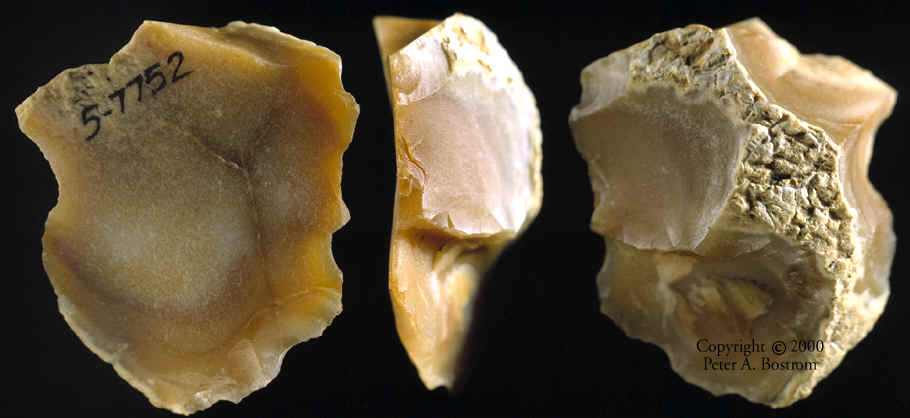
By taking cranial endocasts, plastic casts of the interior of a fossilized hominid’s skull, Croom reports that scientists were able to determine that:
the parietal, occipital, and temporal lobes of the brain merge for the first time in Homo habilis, creating an area of the brain called the POT, or Wernicke's Area. Broca's Area,
one of the other highly important areas involved in language production and processing, can supposedly also be observed for the first time in the hominid line from endocasts of Homo habilis skulls. The argument that follows from this evidence is that the Broca's and Wernicke's areas were selected for in Homo habilis in order to make tools (and probably also for gathering food and hunting), but were subsequently exapted by later humans for the purposes of language production and processing(Croom).
Now, this does not cement the idea that language began with the handymen of the Lower Paleolithic, it is an intriguing idea that those areas of the brain—Broca’s and Wernicke’s areas—responsible for syntactic structure(Ramachanrdan 295)(which could be synonymous with constructing a tool, properly, in fit and handle, to reach the hominid’s desired end, ie, dead animal=dinner; felled brush and trees=shelter,etc) and for comprehending language and producing writings and speeches that are anything but platitudes(305)(which in and of itself could be congruent with the idea that while you may have a functioning side scrapers, knives, choppers, picks, and hand-axes, their sustainability and well, beauty, may have attracted, in addition to food, shelter, etc., those amorous companions who allow the lineage of a species, family, and identity to continue and flourish)were also undoubtedly merged during the “durance” of our earliest hominids within cavities and bodies that were at once thought to be rudimentary.
Growing from this idea, Dr. Mark Liberman introduces—in his essay “Darwin and Deacon on Love and Language: —the idea that while tool-making was the genesis of language, the systole that marks language as evolving and refining itself is the old “hunter-gather-mate,” concept. Liberman quotes Terence Deacon’s book The Symbolic Species,” in saying that what began as communicating in symbols(grunts, groans, calls, etc.)evolved into something much more richer and, well, easier:
Even a small, inefficient, and inflexible symbol system is very difficult to acquire, depends on significant external social support in order to be learned, and forces one to employ very counterintuitive learning strategies that may interfere with most nonsymbolic learning processes. The first symbol systems were also likely fragile modes of communication: difficult to learn, inefficient, slow, inflexible, and probably applied to a very limited communicative domain[. . . .]Neurologically and semiotically, symbolic abilities do not necessarily represent more efficient communication, but instead represent a radical shift in communicative strategy"(Liberman).
In keeping with this idea of language being concomitant of tool-making and symbol-usage, if one does not find ways to eat and keep from the elements(cold, heat, wind, rain, etc.), that being perishes; parallel to this idea, if one does not procreate, that being(and perhaps, that species and lineage)perishes. Be it ego or an embodiment of guile, human beings are like sparrows, snakes, and alligators: None of them want to die. Thusly, Liberman, in quoting Deacon, postulates that what symbols were used as warning, defense, or in conquest, were then transmuted into wholly new articulations(tool-making into language)that bespoke of one’s vitality and ability to procreate and sustain lineages—call it a primordial social contract akin to marriage:
The pair-bonding relationship in the human lineage is essentially a[ . . . ]set of promises that must be made public. These [. . . ]implicitly determine which future behaviors are allowed and not allowed; that is, which are defined as cheating and may result in retaliation[…](f)or a male to determine he has paternity certainty, requires that other males also provide some assurance of their future sexual conduct. Similarly, for a female to be able to give up soliciting provisioning from multiple males, she needs to be sure that she can rely on at least one individual male who is not obligated to other females to the extent that he cannot provide her with sufficient resources(Liberman).
Such is the provenance, perchance, of the execrations, the vespers, the frightful liturgy, and awe-inspiring expatiations that were once laved in a caul that first brought with them, a taste of iron and wood, and when diffluent, thus melted down the throat and traced in the as stomach the earliest pangs of riveting branch-to-branch, arc-to-arc, mortise-to-tenon, that bloomed out of a moiling, itself both arduous and exploratory, which would measure Homo habilis as to its capacity for evolving and witnessing the permutations of its developing and future society as in thrall to the vicissitudes of those hominins at present in our past. And thus, rather than working to exclusively build temples, out-houses, forts, and pyres, efforts themselves diluent if none would be standing in generations yet to to come, these hominins sought to urge a topography for animate beings’ emotions, desires, wants, and intimations through spoken words, their order and phrasing near encomium, to the condition of being alive.
P.S. I included a great video starring David Crystal, a British linguist who wrote a wonderful tome entitled Walking English which explored the dialectical spread of Gaelic throughout Ireland, from Kerry to Derry. Dr. Crystal appears on a BBC show in the video declaring his theory that text messaging is in fact encouraging literacy. Have a peek:
WORKS CITED
Croom, Christopher. “Language Origins: Did Language Evolve Like the Vertebrate Eye, or Was It More Like Bird Feathers?” csa.com. Cambridge Publishing Group, 2003. Internet. Wed. 9 February 2010
McCarthy, Cormac. Outer Dark. 2nd ed. New York: Vintage, 1993. Print
Ramachandran, V.S. The Tell-Tale Brain. New York: W.W. Norton & Company, 2011. Print
Stein, Phillip L., and Rowe, Bruce M. Physical Anthropology. 9th ed. New York: McGraw Hill. 2003. Print
Liberman, Mark. “Darwin and Deacon on Love and Language.” Language Log. 2nd ed. University of Pennsylvania, 2004. Internet. 9 February 2010.
